Rock, Mineral, and Fossil Education
Starting a Rock Collection: Tools, Places, and First Steps
Rock collecting is one of the easiest hobbies to start. You do not need expensive equipment or special access, just curiosity, a few basic tools, and some awareness of where collecting is allowed. This guide covers what to bring, where to look, and the habits that turn a box of interesting stones into a real collection.
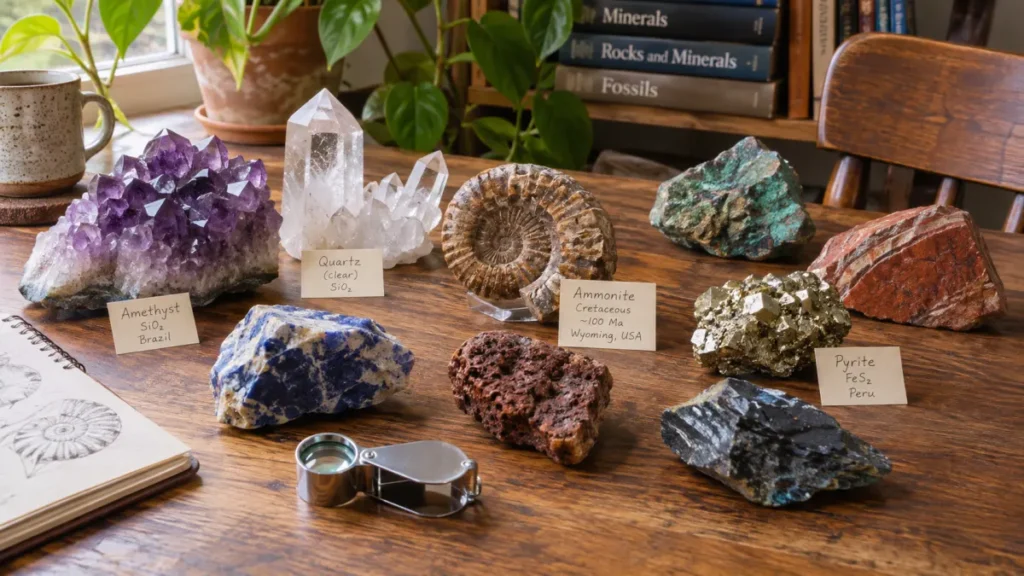
Decide What Interests You
Some collectors want a little of everything, while others focus early. Common themes include minerals from a single region, quartz varieties, fossils from a particular period, or specimens that show a certain property such as fluorescence. A focus is not required, but it helps you decide what to keep and makes it easier to learn deeply. If you are not sure yet, start broad and let your interests develop.
Basic Tools
A starter kit can be assembled cheaply:
- Hand lens (10x loupe) for examining crystals, grain textures, and small fossils.
- Rock hammer with a flat end for striking and a pick or chisel end for splitting.
- Safety glasses. Rock chips fly fast and are sharp. Wear eye protection whenever you hammer.
- Gloves to protect your hands from sharp edges.
- Streak plate (unglazed porcelain) and a steel nail for identification tests.
- Small magnet for detecting magnetic minerals.
- Bags, newspaper, or egg cartons to keep specimens from knocking together.
- Notebook and marker for recording where each piece came from.
How to use the identification tools is explained in Reading a Rock.
Where to Look
- Beaches, riverbanks, and gravel bars sort and expose many rock types, and agates, jasper, and fossils often turn up there.
- Road cuts expose fresh rock layers, but traffic makes them dangerous and collecting may be prohibited, so check local rules first.
- Quarries and old mine dumps can be excellent sources, but only with explicit permission from the owner or operator.
- Fee-dig sites let you collect for a fee on private land and are a good way to find quality material legally.
- Rock shops and mineral shows are the easiest way to acquire well-labeled specimens from places you cannot visit.
- Local rock, gem, and mineral clubs often organize field trips to sites that individuals cannot access, and members share knowledge freely.
Collecting Rules and Permission
Collecting rules depend on who owns or manages the land. In the United States, a few general patterns apply:
- Private land always requires the owner’s permission.
- National parks and national monuments generally prohibit collecting of any rocks, minerals, or fossils.
- Bureau of Land Management land often allows casual collecting of common rocks, minerals, invertebrate fossils, and limited amounts of petrified wood for personal use.
- Vertebrate fossils such as bones and teeth on federal land generally may not be collected without a permit.
- State lands have their own rules, which vary widely.
Rules change and have local exceptions, so check with the land manager before you go. Other countries have their own laws, and some restrict the export of fossils and minerals entirely.
Record Everything
The single most valuable habit in collecting is recording where each specimen came from. A specimen with a precise locality is scientifically useful and far more interesting, while the same piece with no locality is just a pretty rock. For each find, note the date, location as precisely as possible, the type of rock it came from, and any observations. Give each specimen a number that matches your notes. The next article, Caring for a Mineral Collection, covers labeling and storage in more detail.
Learning as You Go
Every new specimen is a chance to practice identification. Start with the common minerals and fossils you are most likely to encounter, such as quartz and the groups in Common Fossils Collectors Find. A good regional field guide, a mineral database, and a local club will speed things up considerably. Over time, you will begin to recognize many specimens at a glance and know which tests to reach for when you do not.
© 2026 Steiner Collectables
Theme by Anders Noren — Up ↑