Rock, Mineral, and Fossil Education
Understanding What You're Actually Holding
An independent educational resource on crystals, gemstones, minerals, rocks, and fossils for collectors, students, and the curious.
Rock, Mineral, and Fossil Education for Collectors
Pick up a crystal, a fossil, or a polished gemstone, and it is easy to appreciate how it looks without understanding what it actually is, how it formed, or how it differs from the rock sitting next to it on the shelf. Steiner Collectables is an educational resource built to close that gap.
We explain the real differences between crystals, gemstones, minerals, and rocks, how fossils form over geological time, how gemstones are defined and labeled, and how to start identifying specimens using simple physical tests. Every article is written for people who are curious but not necessarily trained in geology, so technical terms are explained the first time they appear.
The articles are grouped into four topics below. Each one stands on its own, but they also build on each other, and links throughout the site point you to the next logical step.
This site is educational, not transactional. We are not a dealer, appraiser, or authentication service, and we do not buy, sell, grade, or authenticate specimens.
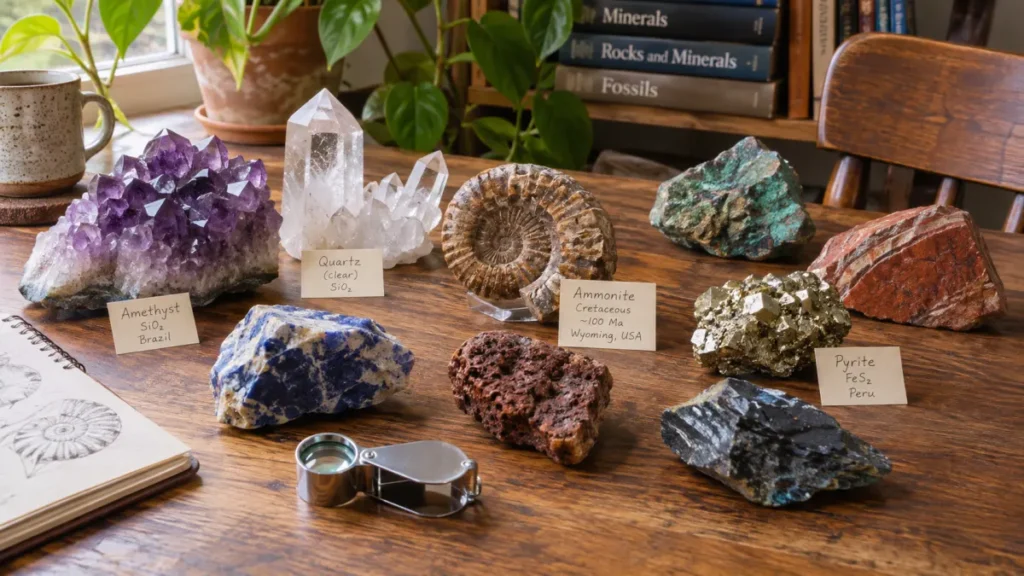
Minerals, Crystals, and Rocks
The vocabulary and science underneath everything else on this site: what minerals are, how crystals grow, and how rocks are classified.
Crystals vs. Gemstones vs. Minerals: What’s Actually the Difference?
The starting point. What separates a mineral from a crystal, a gemstone, a mineraloid, and a rock, with everyday examples of each.
How Crystals Grow: From Atoms to Visible Faces
Nucleation, cooling rates, geodes, and hydrothermal veins: why some minerals grow sharp faces while others stay rough.
The Three Types of Rocks: Igneous, Sedimentary, and Metamorphic
How igneous, sedimentary, and metamorphic rocks form, how the rock cycle links them, and how to tell them apart by eye.
Quartz and Its Many Varieties: Amethyst, Citrine, Agate, and More
Amethyst, citrine, smoky quartz, agate, jasper, and chalcedony are all one mineral. Here is how they differ.
Understanding Gemstones
Gemstones are defined by how people use a material rather than by its chemistry. These articles explain the qualities that matter and the labels you will see.
What Makes a Gemstone? Beauty, Durability, and Rarity
Color, brilliance, hardness, toughness, and stability, and why many beautiful minerals are never cut as gems.
Natural, Synthetic, and Simulated Gemstones: What the Terms Mean
Lab-grown, simulated, treated, and composite stones explained, and why the labels matter.
Organic Gems: Pearl, Amber, Jet, and Coral
Pearl, amber, jet, and coral come from living things. How each forms and how to care for it.
Fossils and Ancient Life
Fossils record the history of life, but only under the right conditions. Learn how they form, what they reveal, and which ones collectors see most often.
How Fossils Form: From Ancient Life to Stone
Rapid burial, permineralization, replacement, molds, casts, and trace fossils: the main routes from living thing to stone.
How Petrified Wood Forms: When Trees Turn to Stone
How silica-rich water turns buried trees into stone, where the colors come from, and the best-known deposits.
Index Fossils: How Fossils Help Date Rock Layers
How certain short-lived, widespread species let geologists date and match rock layers around the world.
Common Fossils Collectors Find: Ammonites, Trilobites, Crinoids, and More
Ammonites, trilobites, crinoids, brachiopods, and shark teeth: the fossils most collections start with.
Identifying and Collecting Specimens
Practical guides for working out what a specimen is and keeping a collection in good condition.
Reading a Rock: An Introduction to Rock and Mineral Identification
Hardness, luster, streak, cleavage, habit, and heft: the practical tests that work better than color.
Starting a Rock Collection: Tools, Places, and First Steps
Basic tools, good places to look, collecting rules and permissions, and why recording locality matters.
Caring for a Mineral Collection: Cleaning, Storage, and Labeling
Cleaning, storage, labeling, and which minerals are damaged by water, light, or humidity.
Common Questions
Is every crystal a gemstone?
No. A crystal describes a mineral’s orderly internal structure and, when visible, its geometric growth form. A gemstone is a material valued and usually cut for beauty and durability. Many crystals, such as calcite and halite, are far too soft to ever be used as gems.
Can color alone identify a mineral?
Not reliably. Trace impurities can give the same mineral many colors, and different minerals can share the same color. Hardness, luster, streak, and cleavage are much more consistent identifying tools.
Do all fossils preserve the original organism?
No. Mold and cast fossils preserve only the shape of an organism, trace fossils preserve its footprints or burrows, and permineralized fossils fill the original structure with minerals. Amber and permafrost are among the few settings that preserve original material with little change.
Is a lab-grown gemstone fake?
A lab-grown, or synthetic, gemstone has essentially the same chemistry and properties as the natural stone, so it is real material made in a laboratory. A simulant is different: it only imitates the look of a gem using another material, such as glass or cubic zirconia.
Why are most fossils found in sedimentary rock?
Fossilization usually requires quick burial in sediment such as mud or sand. Igneous rocks form from molten material that destroys remains, and metamorphism usually distorts or erases fossils, so sedimentary rocks hold nearly all of the fossil record.
Where should I start if I am new to this topic?
Begin with the difference between crystals, gemstones, and minerals for the vocabulary, then the identification basics for the hands-on tests. When you are ready to build a collection, the guide to starting a rock collection covers tools and rules.
© 2026 Steiner Collectables
Theme by Anders Noren — Up ↑