Rock, Mineral, and Fossil Education
Quartz and Its Many Varieties: Amethyst, Citrine, Agate, and More
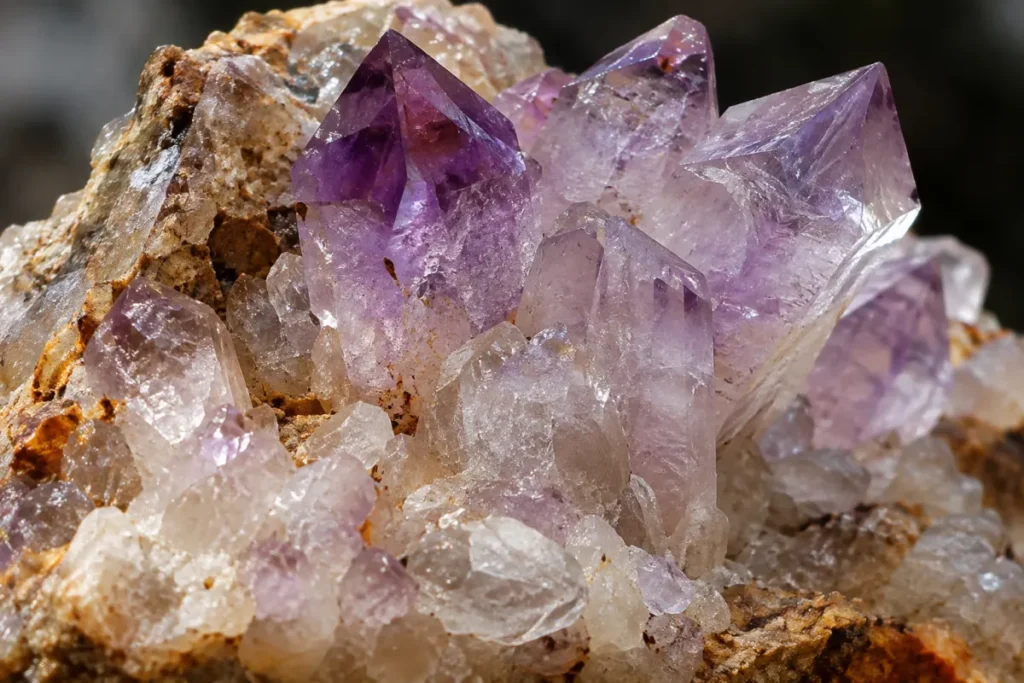
If you own more than a handful of rocks, you almost certainly own quartz, possibly under several different names. Amethyst, citrine, smoky quartz, agate, jasper, and carnelian are all varieties of the same mineral, silicon dioxide (SiO2). Quartz is one of the most abundant minerals in Earth’s continental crust, second only to the feldspar group, and its range of colors and textures makes it a natural starting point for any collector.
What Makes Quartz Quartz
Every variety shares a core set of properties, which makes quartz one of the easier minerals to recognize:
- Hardness of 7 on the Mohs scale, so it scratches glass and steel.
- No cleavage. Quartz breaks with a curved, shell-like conchoidal fracture, much like thick glass.
- Glassy (vitreous) luster on crystal faces and fresh breaks.
- Six-sided crystals that typically end in a pointed termination when they have room to grow.
Quartz also has an unusual electrical property called piezoelectricity: squeezing a crystal produces a small electric charge. This is why quartz crystals, now mostly synthetic, keep time in watches and electronics.
Crystalline Varieties
These varieties form visible crystals, and their colors come from trace elements, natural radiation, or tiny inclusions:
- Rock crystal: clear, colorless quartz.
- Amethyst: purple quartz. Its color comes from traces of iron combined with natural radiation in the surrounding rock. Some amethyst fades with long exposure to strong sunlight.
- Citrine: yellow to orange quartz. Natural citrine is relatively uncommon, and much of the citrine on the market is heat-treated amethyst, which often shows a deeper orange color concentrated at the crystal tips.
- Smoky quartz: brown to nearly black, colored by natural irradiation acting on traces of aluminum.
- Rose quartz: pale pink. It rarely forms distinct crystals and usually occurs in massive pieces. Research has linked its color to microscopic fibrous inclusions.
Ametrine, a single crystal with zones of both amethyst and citrine color, shows how small changes in growth conditions can be recorded inside one specimen. For more on those conditions, see How Crystals Grow.
Microcrystalline Varieties: Chalcedony, Agate, and Jasper
Not all quartz forms crystals you can see. Chalcedony is made of quartz fibers and grains so fine that they are only visible under a microscope. It has a waxy luster rather than a glassy one and is slightly softer and less dense than crystalline quartz. Several popular varieties belong to this group:
- Agate: chalcedony with concentric or parallel bands, often formed inside cavities in volcanic rock. Many agates are dyed to brighter colors before sale.
- Carnelian: translucent orange to red chalcedony colored by iron oxides.
- Onyx: chalcedony with straight, parallel bands, traditionally black and white.
- Jasper: opaque, usually red, yellow, brown, or green, and often containing a large share of other minerals. Because of those impurities, some mineralogists treat jasper as closer to a rock than a pure mineral variety.
Chert and flint are also microcrystalline quartz. Their conchoidal fracture and sharp edges made them the preferred stone for tools across much of human history.
Quartz Look-Alikes
Several common materials can be confused with quartz:
- Calcite can look similar but is only hardness 3, so a steel nail scratches it easily, and it breaks along flat cleavage planes.
- Glass often contains round bubbles and swirl marks, and it lacks the natural six-sided crystal shape.
- Fluorite can be purple like amethyst but is hardness 4 and splits into flat octahedral pieces.
A simple hardness test separates most of these. The full method is in Reading a Rock.
Where Quartz Turns Up
Quartz occurs in all three rock families. It is a major part of granite, it makes up most beach and desert sand, and it forms the bulk of sandstone and quartzite. Some of the best-formed crystals grow in hydrothermal veins and geodes, while chalcedony and agate often fill cavities in volcanic rock. Its durability is the reason quartz survives weathering so well: long after softer minerals have dissolved or crumbled, quartz grains remain. The article on the three types of rocks explains how those grains move through the rock cycle.
© 2026 Steiner Collectables
Theme by Anders Noren — Up ↑