Rock, Mineral, and Fossil Education
Common Fossils Collectors Find: Ammonites, Trilobites, Crinoids, and More
Many fossil collections start with the same handful of groups. They are common because the animals were abundant, had hard parts that preserved well, and lived in shallow seas where sediment buried them quickly. This guide covers the fossils you are most likely to find in rock shops, on beaches, and in road cuts, along with a few tips for recognizing each one.
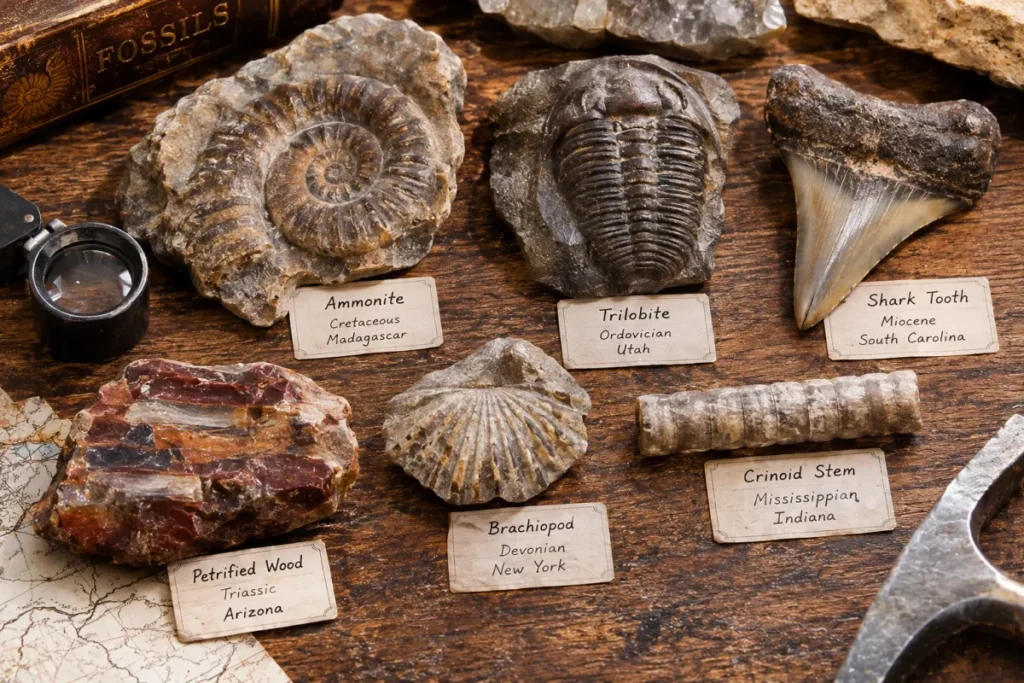
Ammonites
Ammonites were marine cephalopods, relatives of today’s octopus, squid, and nautilus, that lived inside coiled, chambered shells. They first appeared roughly 400 million years ago and became extinct at the end of the Cretaceous Period, about 66 million years ago, in the same event that ended the non-bird dinosaurs.
Look for the suture lines on the shell, the intricate wavy patterns where internal chamber walls met the outer shell. Their complexity changed over time, which helps make ammonites useful index fossils. Many ammonites sold today are cut and polished in half to show their internal chambers, and some from Madagascar and Morocco are naturally replaced by colorful minerals.
Trilobites
Trilobites were marine arthropods, distantly related to insects, crabs, and spiders. Their name refers to the three lengthwise lobes of their bodies. They appeared in the Cambrian Period, more than 500 million years ago, and disappeared in the mass extinction at the end of the Permian, about 252 million years ago.
Trilobites had hard exoskeletons that they shed as they grew, so many fossils are actually molted shells. Elrathia kingii from Utah is one of the most commonly collected species. Be cautious with elaborate, spiny specimens from commercial sources: some are heavily restored or are cast replicas, so buy from reputable dealers and ask about restoration.
Crinoids
Crinoids, often called sea lilies, are echinoderms, relatives of starfish and sea urchins. Despite their plant-like look, they are animals that anchored to the seafloor with a long stem and filtered food with feathery arms. Some species still live in today’s oceans.
Complete crinoid fossils are uncommon, but their stem segments, small disks or stacked columns with a hole through the center, are among the most abundant fossils in many limestones. They are sometimes nicknamed “Indian beads” in parts of North America.
Brachiopods
Brachiopods look like clams at first glance, but they belong to a separate group of animals. The easiest way to tell them apart: a clam’s two shells are mirror images of each other, while a brachiopod’s two shells differ from each other but are each symmetrical from side to side. Brachiopods were extremely common in Paleozoic seas, and limestone and shale from that era can be packed with them.
Shark Teeth
Sharks have skeletons made of cartilage, which rarely fossilizes, but they constantly shed and replace their teeth, and a single shark can lose thousands of teeth over its life. Those teeth are made of hard, mineral-rich material that preserves well, which is why fossil shark teeth are so common on certain beaches and riverbeds.
The best-known are the giant teeth of Otodus megalodon, an extinct shark that lived from roughly 23 to 3.6 million years ago. Fossil teeth are usually darker than modern ones because minerals from the surrounding sediment have replaced or stained the original material.
Gastropods, Corals, and Petrified Wood
- Gastropods (snails) have a long fossil record and are common in many sedimentary rocks. Some fossils are molds or internal casts of the shell rather than the shell itself.
- Horn corals, named for their curved, horn-like shape, were solitary corals common in Paleozoic seas and became extinct at the end of the Permian.
- Petrified wood is one of the most popular plant fossils and is covered in detail in How Petrified Wood Forms.
Collecting Responsibly
Rules for fossil collecting vary by location and by type of fossil. In the United States, casual collecting of common invertebrate fossils and petrified wood is allowed on much public land managed by the Bureau of Land Management, within limits, while vertebrate fossils on federal land generally require a permit. National parks prohibit collecting altogether, and private land requires the owner’s permission. The article Starting a Rock Collection covers tools and first steps, and the background on how these fossils formed is in How Fossils Form.
Related Reading
- How Fossils Form: From Ancient Life to Stone
- Index Fossils: How Fossils Help Date Rock Layers
- How Petrified Wood Forms: When Trees Turn to Stone
Browse every topic from the Steiner Collectables homepage.
© 2026 Steiner Collectables
Theme by Anders Noren — Up ↑